
Last Updated on February 18, 2026 by Rajeev Bagra
Many learners start their AI journey with courses like CS50 AI or books such as Artificial Intelligence: A Modern Approach. These are excellent for understanding how AI works in software.
But when you look at real AI products—robots, drones, smart devices—you realize they live in the physical world.
So how do you go from:
✅ Writing Python models
➝ 🚀 Building intelligent machines?
This post gives you a step-by-step roadmap to make that transition.
🧩 Stage 1: Build a Strong AI & Programming Foundation
Before touching hardware, you must be confident with core AI and software skills.
Learn These First
- Python (NumPy, Pandas, Matplotlib)
- Machine Learning basics
- Search, Planning, Reasoning
- Neural Networks
- Reinforcement Learning
- Computer Vision (OpenCV)
Recommended Resources
- CS50 AI with Python
- Andrew Ng’s ML courses
- Practice on Kaggle
- GitHub AI projects
🎯 Goal: Be comfortable building AI models on your laptop.
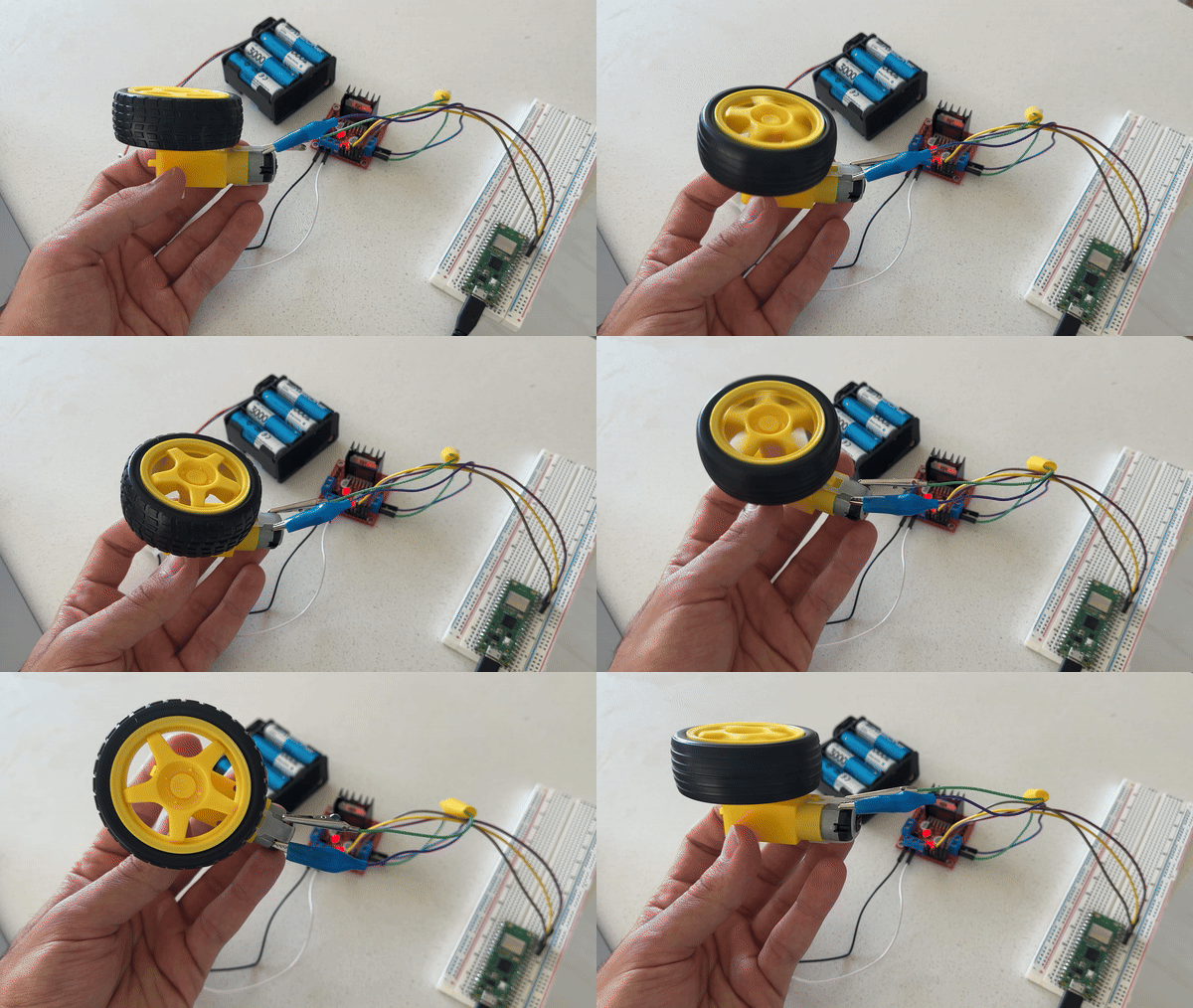
🤖 Stage 2: Learn Basic Electronics & Embedded Systems
Now you move from “screen” to “real world”.
You must understand how machines sense and act.




What to Learn
- Voltage, current, resistors
- Sensors (distance, camera, temperature)
- Motors (DC, Servo, Stepper)
- Microcontrollers
- GPIO pins
Starter Platforms
- Arduino
- Raspberry Pi
- ESP32
Beginner Projects
- Obstacle-avoiding robot
- Line follower
- Smart light system
- Sensor-based alarm
🎯 Goal: Make hardware respond to code.
🧠 Stage 3: Connect AI Models to Hardware
Here, AI meets electronics.
You start using your trained models to control physical devices.
Key Skills
- Sending data from sensors to Python
- Running ML models on devices
- Controlling motors via predictions
- Using cameras for vision
Example Projects
- Face-recognition door lock
- Object-following robot
- Voice-controlled robot
- Gesture-controlled car
Tools
- OpenCV
- TensorFlow Lite
- PyTorch Mobile
- MQTT / Serial communication
🎯 Goal: Let AI decisions control real-world actions.
🧩 Stage 4: Learn Robotics Frameworks (ROS)
Professional robots don’t run on “simple scripts”.
They use structured systems.
That system is usually ROS (Robot Operating System).


Why ROS Matters
ROS handles:
- Sensors
- Navigation
- Mapping
- Localization
- Path planning
- Multi-module communication
Learn These Concepts
- Nodes
- Topics
- Services
- SLAM
- Navigation Stack
- RViz
- Gazebo Simulation
Learning Resources
- ROS Tutorials
- The Construct Robotics
- Udemy ROS courses
🎯 Goal: Build scalable, industry-grade robots.
🌍 Stage 5: Practice in Simulation First
Before buying expensive hardware, test in virtual worlds.


Why Simulation?
- No hardware damage
- Faster testing
- Unlimited experiments
- Cheap learning
Popular Simulators
- Gazebo
- Webots
- CARLA (Self-driving)
- OpenAI Gym
🎯 Goal: Train and test AI safely before deployment.
🚗 Stage 6: Build End-to-End AI Robots
Now you are ready for complete products.


Real-World AI Products
- Delivery robots
- Smart vacuum cleaners
- Warehouse robots
- Agricultural drones
- Surveillance robots
- Assistive robots
Full System Stack
Sensors → AI Model → Decision → Motor Control → Feedback → Learning
You’ll combine:
- AI models
- ROS
- Embedded systems
- Cloud services
- Mobile apps
🎯 Goal: Build commercial-grade AI products.
📚 Complete Learning Roadmap (Beginner → Pro)
Phase 1: Software AI (0–6 months)
✔ Python
✔ ML/AI fundamentals
✔ Projects on Kaggle
Phase 2: Electronics (3–6 months)
✔ Arduino/Raspberry Pi
✔ Sensors & motors
✔ Mini robots
Phase 3: AI + Hardware (6–12 months)
✔ Vision systems
✔ Edge AI
✔ Smart robots
Phase 4: Robotics Systems (1+ year)
✔ ROS
✔ Simulation
✔ Autonomous navigation
Phase 5: Product Building
✔ Real deployments
✔ Prototypes
✔ Startups/Research
🔧 Must-Have Resources
Books
- Artificial Intelligence: A Modern Approach
- Probabilistic Robotics (Thrun)
- Learning ROS for Robotics
Online Platforms
- Coursera / Udemy Robotics
- The Construct
- YouTube: Robotics channels
- GitHub robotics projects
Hardware Kits
- Arduino starter kit
- Raspberry Pi robot kit
- LIDAR modules
- Camera modules
💡 Career Insight: Why This Path Matters
If you only know software AI:
❌ You are limited to apps and websites.
If you know AI + Robotics:
✅ You can build:
- Autonomous vehicles
- Smart factories
- Healthcare robots
- Defense systems
- Space tech
This combination is one of the highest-paying and most future-proof skills.
🌱 Beginner’s First Project (Start Today)
Try this simple roadmap:
Month 1–2
👉 Buy Arduino + ultrasonic sensor
👉 Build obstacle robot
Month 3–4
👉 Add Raspberry Pi + camera
👉 Add OpenCV
Month 5–6
👉 Train object detection
👉 Control robot with AI
Month 7+
👉 Learn ROS
👉 Build navigation robot
✨ Final Thought
AI in the real world is not just about algorithms.
It is about connecting intelligence to action.
🧠 + ⚙️ + 💻 + 🌍 = Real AI Products
If you master this path, you move from:
AI learner ➝ AI engineer ➝ AI innovator
Discover more from Aiannum.com
Subscribe to get the latest posts sent to your email.
Leave a Reply